Oklahoma Administrative License Suspension Hearing
Estimated Read Time: 8-9 Minutes
In the immediate aftermath of an arrest in Oklahoma, the most important decisions are made quickly and carry lasting consequences. The administrative license suspension process is not just a procedural option. Instead, think of it as a powerful legal tool designed to challenge the State’s authority, test the validity of the arrest, and protect your ability to maintain control over your daily life. Your license is tied directly to your independence, your livelihood, and your ability to defend yourself effectively. Taking action within the limited timeframe forces the government to justify its case under scrutiny, while inaction allows penalties to take hold without resistance. This is where the balance shifts. Either you assert your rights and demand accountability, or you allow the process to move forward unchecked.
Key Takeaways:
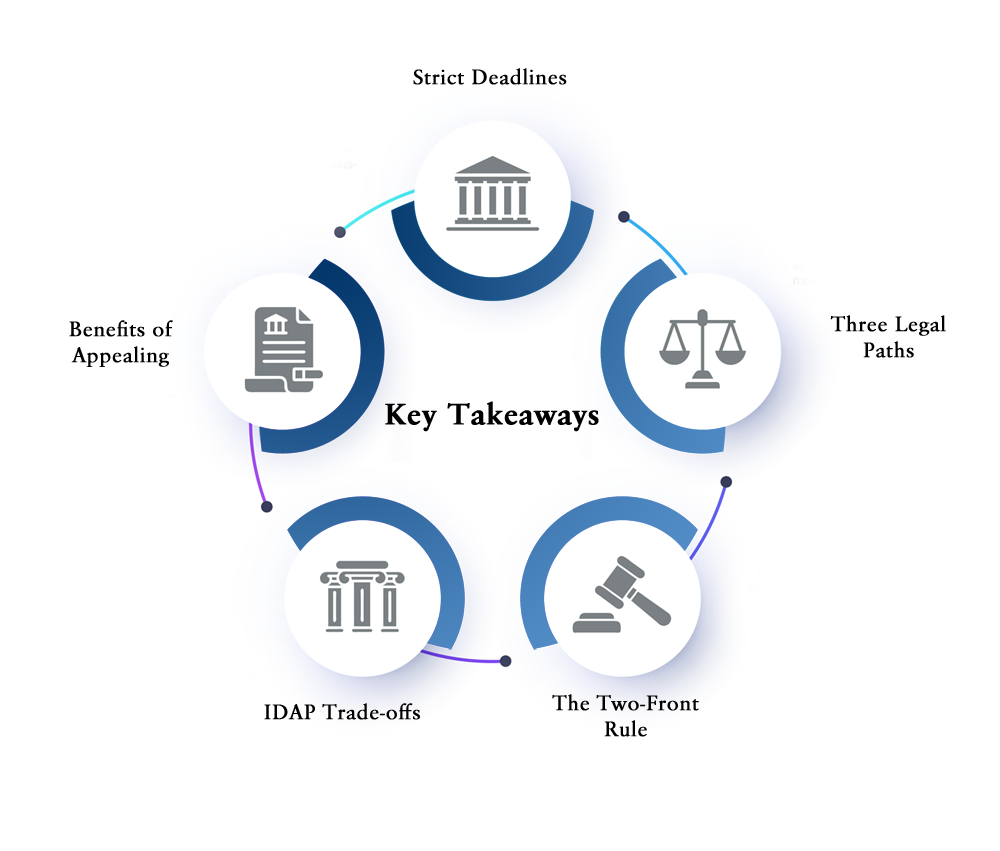
Strict Deadlines: You have exactly 30 days from the date of your arrest or notice to formally request a hearing or choose a program, or your license will be automatically revoked.
Three Legal Paths: Drivers can choose to fight the license loss in district court, enter the Impaired Driver Accountability Program, or simply accept the revocation.
Benefits of Appealing: Filing a district court appeal allows you to request a stay of execution, which lets you keep your full, unrestricted driver’s license while waiting for your trial.
IDAP Trade-offs: While the IDAP program keeps a revocation off your public record, it requires you to pay for a breath test and waive your right to fight the arrest in court.
The Two-Front Rule: Winning an administrative license appeal does not end the criminal case. A later conviction in criminal court will trigger a brand-new mandatory revocation
The Important Next Steps After Your Arrest
After an arrest in Oklahoma, your driver’s license is immediately at risk, but the suspension is not automatic unless you allow it to be. The outcome depends entirely on whether you act within the strict legal deadline. The State itself acknowledges that arrests can be flawed, which is why the Administrative License Suspension process exists. It helps provide a built-in due-process safeguard before your driving privileges are taken away. However, that protection only works if you use it. You have 30 days from the date of arrest or notice to formally request an ALS hearing with the Oklahoma Department of Public Safety. If you miss that deadline, the suspension is imposed without challenge, and your opportunity to contest it is gone.
Requesting an ALS hearing is a strategic move that forces the government to justify its actions under scrutiny. At this hearing, the State must establish that the initial stop was lawful, that probable cause existed for the arrest, and that any chemical testing was conducted properly and in compliance with regulations. This is often the first opportunity to challenge the officer’s version of events in front of a judge. The officer is required to testify under oath, and that testimony becomes part of the record, creating a powerful advantage if inconsistencies or weaknesses emerge later in the criminal case. In addition, the ALS hearing serves as an early discovery tool, allowing the defense to examine evidence such as testing procedures, calibration records, and the legality of the stop well before trial. By taking this step, you also disrupt the State’s assumption that the suspension will go unchallenged, forcing it to meet its burden of proof rather than relying on default enforcement.
 Three Ways for Handling Your Driver’s License
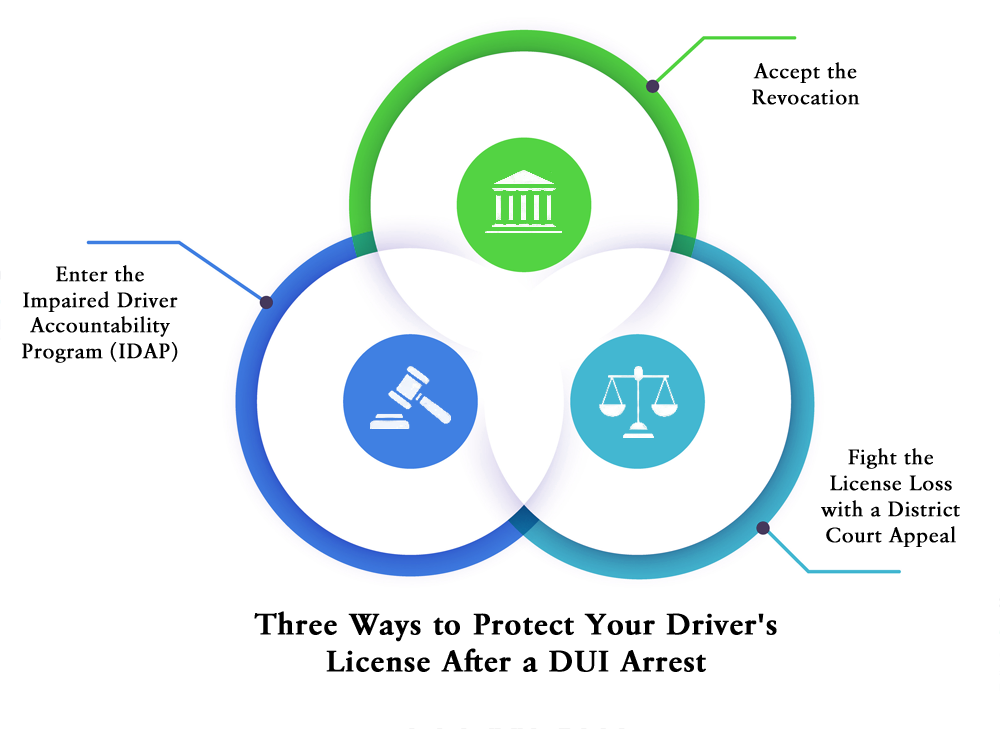
When you are arrested for a DUI or APC in Oklahoma, the state gives you three specific paths to handle your driver’s license. You only have 30 days from the date of your arrest to make a decision, otherwise your license will be automatically revoked.
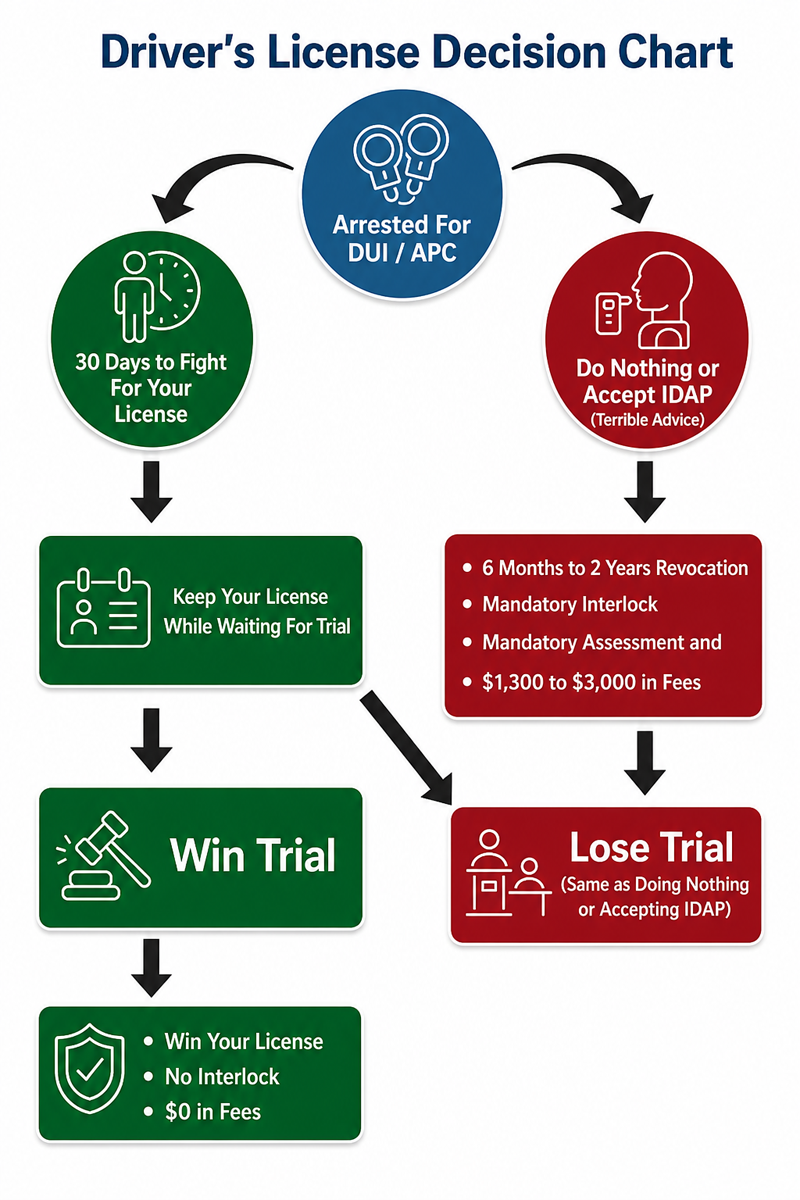
You do not need to simply accept the revocation, which happens if you do nothing within those first 30 days. If you decide not to act, your license will become invalid on the 31st day. This will be marked on your permanent driving record for insurance companies and employers to see. For a first offense, this usually means you cannot drive at all for 180 days. Once that time is up, you have to pay significant fees to the state and usually still have to put an interlock device in your car before you can get your full license back.
Another option is the Impaired Driver Accountability Program. This is a deal where you agree to install an ignition interlock device in your car for a set period. In exchange for doing this, the revocation never goes on your public driving record, which helps keep your insurance rates from skyrocketing and protects your background check for jobs. However, by choosing this, you give up your right to fight the suspension.
The most proactive option is to fight the license loss by filing a district court appeal. When you assert this right, a judge reviews the evidence against you and the burden of proof is on the state to prove the validity of your arrest. If you win, you keep your license completely. While your case is pending, the judge can often issue a stay, a legal order that allows you to keep driving until the final decision.
And what most don’t realize is that with the right attorney in your corner, the success rate of wining these challenges is high.
Accepting the Revocation
Accepting the revocation is the default outcome if you do not take action within 30 days of your arrest. By choosing this path, either intentionally or by missing your deadlines, you are allowing the state to take your driving privileges without a legal challenge that you are rightfully entitled to. This is generally considered the most damaging option for your long-term driving history and financial situation.
Once that 30-day window closes, your license is automatically canceled on the 31st day. At this point, the revocation is officially entered onto your permanent driving record. Unlike the other options, where the incident can stay off your public record, this revocation is visible to insurance companies, which typically leads to your rates doubling or tripling, or even the cancellation of your policy. It is also visible to any current or future employers who run a background check.
This can be a difficult path. For a first-time offense in Oklahoma, you are usually banned from driving any vehicle for 180 days. During this time, you do not have the right to a restricted license or an ignition interlock device, you simply cannot drive at all. If you are caught driving during this period, you could face new criminal charges for Driving Under Suspension, which carries jail time and even longer license bans.
Getting your license back after the 180 days is over is also a complicated and expensive process. You cannot just start driving again. Instead, you must formally reinstate your license with Service Oklahoma. This involves paying an estimated $315.00 reinstatement fee, providing proof that you have completed an alcohol assessment and a victim impact panel, and often being forced to install an ignition interlock device for a period before you get a regular license back.
Imagine it like this. Sarah is arrested for DUI under similar circumstances, but she hesitates. She assumes the process will sort itself out or that there will be time later to address it. Days turn into weeks. By the time she begins asking questions, the 30-day deadline has quietly passed. The Oklahoma Department of Public Safety moves forward without opposition, and her license is automatically suspended. There is no hearing, no cross-examination, and no opportunity to challenge the legality of the stop or the accuracy of the testing. The consequences hit fast. She loses the ability to drive to work, relies on others for basic tasks, and faces additional financial and personal strain. Even worse, any potential weaknesses in the officer’s case are never exposed early, and no testimony is preserved to use in her defense.
FAQs
How long do I have to save my driver’s license from suspension in Oklahoma? You have exactly 30 days from the date of your arrest or the date you received notice to formally request a hearing or choose a path for your license. If you do not act within this strict window, your license is automatically revoked on the 31st day.
What is the benefit of the Impaired Driver Accountability Program? The primary benefit of IDAP is that it keeps the revocation off your public driving record. However, you must agree to use an ignition interlock device for a set period and waive your right to fight the driver’s license suspension and cross examine the officer, and collect valuable evidence to challenge your criminal case.
What must the state prove to win an appeal hearing? At the hearing, the burden is on the state to prove that the arrest was valid. The judge will examine whether the initial traffic stop was lawful, whether the officer had probable cause to make the arrest, whether the required statements were properly read, and whether all chemical testing was conducted in accordance with legal procedures and regulations. Additionally, mistakes made by law enforcement may be exposed at this hearing, which can be used to argue that the DUI arrest was not justified.
Does winning my appeal mean I am completely finished with the DUI? When you are arrested for DUI or APC, there are 2 legal cases. The driver’s license case and the criminal case. If you beat the driver’s license case, your odds of winning the criminal case go way up. The driver’s license case is the first case. Next, is a criminal case at court. It is best to have a defense attorney challenge both for the best odds of having the case dismissed, reduced, or acquitted.
Impaired Driver Accountability Program
The Impaired Driver Accountability Program, or IDAP, is a way to keep your driving record clean by proving you can drive safely with a breath test in your car. To join, you have to apply and pay a $150.00 fee within 30 days of your arrest. Once you are in, you must install an Ignition Interlock Device in your vehicle. For a first-time offense, you usually have to keep this device for 180 days. The biggest benefit is that if you finish the program successfully, the state will not put the revocation on your public driving record, which prevents your insurance rates from going up and keeps your background check clear for employers.
However, there are several downsides to consider before signing up. This can be an expensive process. Between the state fees and the monthly rental for the device, you could easily spend over $750.00 by the time you are finished. Second, you have to waive your right to fight the case in court, meaning even if the police were wrong, you can’t go back and sue to get your license back later. The device can also be sensitive and may report false positives for things like mouthwash or certain foods, which can result in the state extending your time in the program by several months. Additionally, because the device requires you to blow into it to start the car, it can be embarrassing if you have coworkers or friends in the vehicle. Finally, you must have a working car to participate; if you don’t own one, you can’t use this program to save your record.
 The District Court Appeal
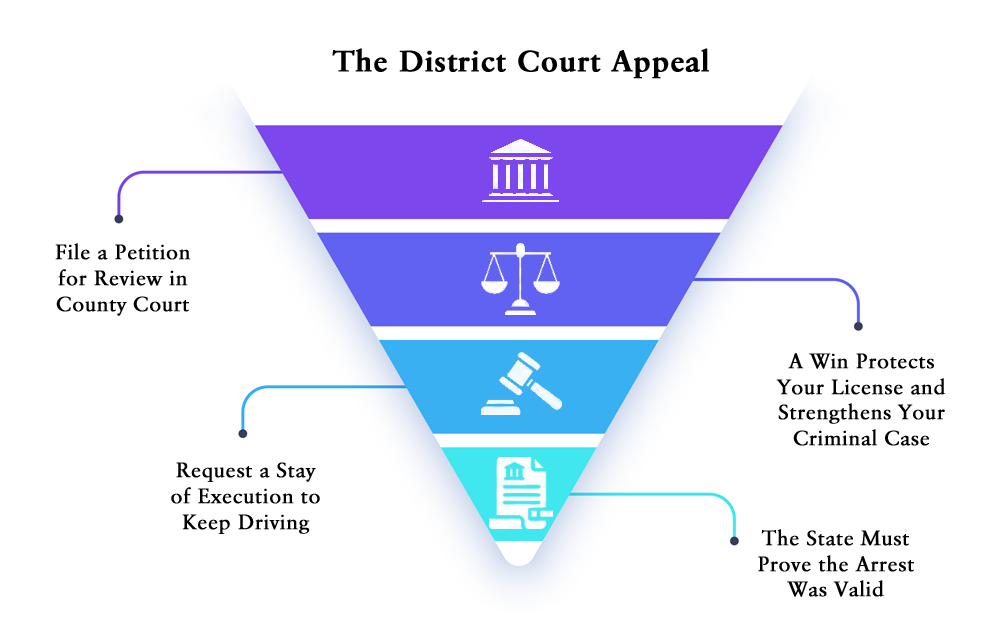
The district court appeal is the path you take if you want to fight the state in court to save your license. Instead of just accepting a restricted license, you or a lawyer file an appeal called a petition for review in the county where you were arrested. You will have to pay a court filing fee, which usually costs between $180.00 and $250.00. The best part of this option is that you can ask the judge for a stay of execution, which is a legal order that lets you keep your regular, full driver’s license while you wait for your trial. This means you don’t have to put a breath test in your car or follow any special rules until the judge makes a final decision.
In court, a judge will listen to the evidence to see if the police followed the law perfectly. The state has to prove that the officer had a good reason to pull you over and that they followed all the official rules for your breath or blood test. If the judge decides the police made a major mistake, they can vacate the revocation, and it will be as if the incident never happened.
While this choice is not without its risks, it can, when wielded correctly, set you up for increased success. Think of it like this. Jake is arrested in Oklahoma for Actual Physical Control while sitting in a parked vehicle. Instead of assuming the situation is hopeless, he acts the same week and files a timely request for an Administrative License Suspension hearing with the Oklahoma Department of Public Safety. That single decision changes everything. His driving privileges remain intact while the case is pending, allowing him to keep working and maintain stability. At the hearing, his attorney zeroes in on a critical issue: whether Jake was truly in control of the vehicle. Under oath, the officer struggles to clearly explain key details, such as where the keys were, whether the engine was running, and what indicators suggested intent to drive. The testimony becomes inconsistent. The judge ultimately rejects the State’s position and sets aside the suspension. Jake walks away with his license, and just as important, with sworn testimony locked into the record that can be used to challenge the prosecution later. What started as a defensive situation quickly became a strategic advantage.
After Filing an Appeal
After you file your appeal in the District Court, the first thing that usually happens is that you receive a stay of execution. This is a legal order that tells the state to pause your license suspension while you wait for your court date. In exchange for a small fee called an appeal bond, you are allowed to keep your regular, full driver’s license. This is a major benefit because it means you can keep driving to work and school without needing a breath test in your car for the time being.
The next step is the court hearing itself, which typically takes place between 30 and 60 days after you file your paperwork. This is a civil trial where a judge, not the police or a state office, looks at the facts of your arrest. The state must bring in witnesses, usually the arresting officer, to prove that they had a legal reason to pull you over and that they followed all the strict state rules for your breath or blood test. This is when the officers can be cross-examined to determine whether they made mistakes or whether the equipment they used was working properly.
Finally, the judge will make a decision. If you win your case, the judge will cancel the revocation entirely, and it will be as if the state never tried to take your license. If the judge decides the state was right, however, the stay is lifted, and your license is revoked immediately. You can choose to appeal the judge’s decision to the Oklahoma Supreme Court within 20 days if you believe the judge made a legal error, but otherwise, you must begin the formal process of getting your license back.
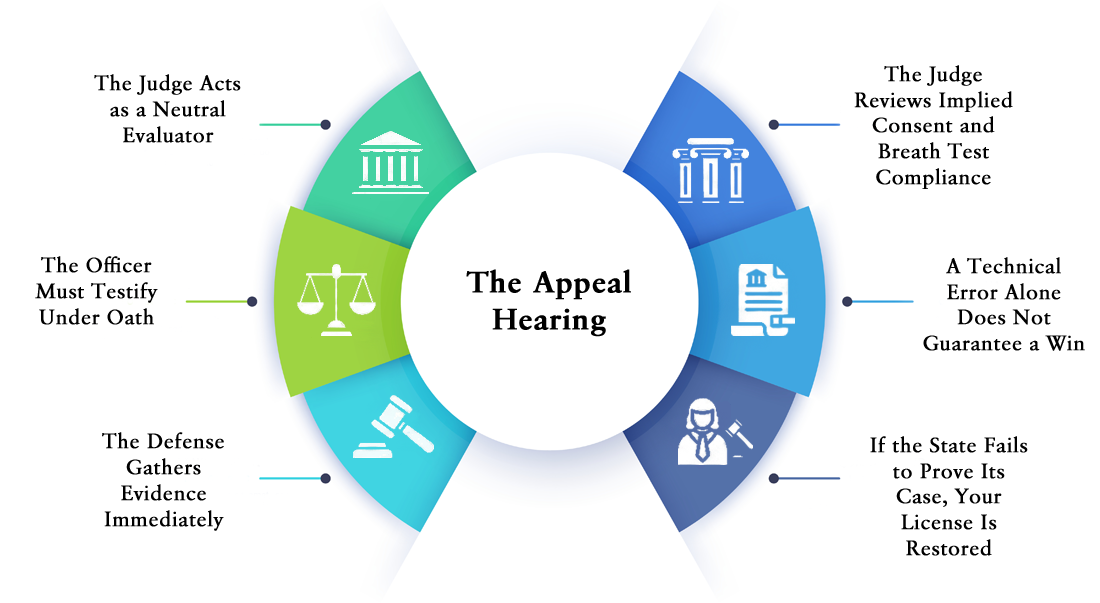 The Appeal Hearing
During an appeal hearing, the judge acts as a neutral evaluator to decide if the state’s decision to revoke your license was legally sound.
At this hearing, the arresting officer is required to testify under oath, often much sooner than they would in a traditional court setting. That testimony is not casual. It is recorded, preserved, and binding. Every detail matters: the stated reason for the stop, the observations used to justify the arrest, and the procedures followed during any field sobriety or chemical testing. This is where inconsistencies surface, and once those statements are made under oath, they cannot easily be changed later without damaging credibility. At the same time, the defense begins gathering evidence immediately, dashcam footage, bodycam recordings, maintenance logs for testing equipment, and procedural records, rather than waiting months when memories fade and evidence becomes harder to access.
Consider a practical example. A woman is driving home and is stopped on suspicion of DUI, despite not having consumed any alcohol. She files a timely ALS appeal with the Oklahoma Department of Public Safety. At the hearing, her attorney presses the officer on the reason for the initial stop. The officer claims she was swerving, but when confronted with the video evidence, the driving appears steady and controlled. The explanation becomes uncertain and inconsistent. As questioning continues, additional issues emerge, standardized testing procedures were not properly followed, and key steps required by protocol were skipped. What initially appeared to be a routine arrest begins to unravel under scrutiny.
At your hearing, the judge will also carefully scrutinize whether the officer followed the mandatory implied consent procedure by reading the exact legal script required that informs you that refusing a test will lead to a license revocation and that you have a right to an independent test at your own expense. If a breath test was performed, the judge will then check for compliance with the Board of Tests rules, specifically the 15-minute deprivation period. During this time, the officer must have observed you continuously to ensure you did not eat, drink, or burp, which could cause a false high reading from mouth alcohol. The judge will also review the maintenance logs for the breath test machine to ensure it was properly certified and inspected within the last 90 days. If any inconsistencies are revealed, these failures will be permanently captured in sworn testimony. These exposed concerns will carry directly into the criminal case, and the prosecution will no longer be relying on an uncontested narrative.
It is important to note that a win is not guaranteed even if there is a technical error with the testing equipment. A judge can still uphold a license revocation if the officer’s sworn report and other competent evidence, such as your driving behavior and physical appearance, strongly suggest you were impaired. This ruling means the judge’s examination covers the full scope of the arrest, not just the scientific test results.
Ultimately, if the state fails to prove any of these critical legal pillars, the judge will vacate the revocation, restoring your full driving privileges and clearing the incident from your public record.
Winning Your Appeal
If you win your appeal in District Court, the judge will issue an order to vacate the revocation, which essentially means the state’s attempt to take your license is canceled and treated as if it never happened. This is the best possible outcome because your full, unrestricted driving privileges are restored immediately. Service Oklahoma is required to clear the pending revocation from your record, meaning you won’t have to pay the typically required $315.00 reinstatement fee, nor will you have to install an ignition interlock in your car.
Because the judge officially ruled that the revocation was not valid, it should not appear on your public driving record. This is vital for your financial and professional life because it prevents insurance companies from seeing a revocation and raising your rates, and it keeps your background check clean for current or future employers. However, it is very important to remember that winning this license appeal only covers the administrative side of your arrest. If you are later convicted of the DUI in criminal court, that conviction will trigger a brand new, mandatory revocation. To keep your license for good, you generally need to avoid a conviction in your criminal case as well.
The Importance of Action: Schedule a Free Case Evaluation Today
The legal system favors those who engage it strategically, and when an individual invokes the right to an ALS hearing in Oklahoma, they immediately place themselves on equal footing with the State. They are no longer passively reacting to allegations. Instead, they begin to actively shape the record, challenge assumptions, and demand accountability at every stage. Court outcomes are not the result of chance. They are driven by preparation, precision, and timing. The party that investigates early, asks the right questions, and exposes inconsistencies gains control. Challenging a driver’s license suspension is one of the earliest and most effective ways to do exactly that.
For that reason, The Edge Law Firm provides a free, no-obligation case evaluation designed to give individuals immediate clarity and direction. During this confidential consultation, clients speak directly with an experienced legal team that understands how to identify and leverage these early opportunities. These evaluations typically last an hour or more, allowing individuals to fully explain their situation while the team asks focused, strategic questions to uncover critical details and begin assessing the case’s strengths and vulnerabilities. Clients are encouraged to ask questions as well, ensuring they leave with a clear understanding rather than uncertainty. Following the consultation, the firm outlines a strategy tailored to the individual’s circumstances and provides a straightforward explanation of what representation would involve. There is no cost and no pressure, only an opportunity to understand available options and determine whether moving forward together is the right decision.